
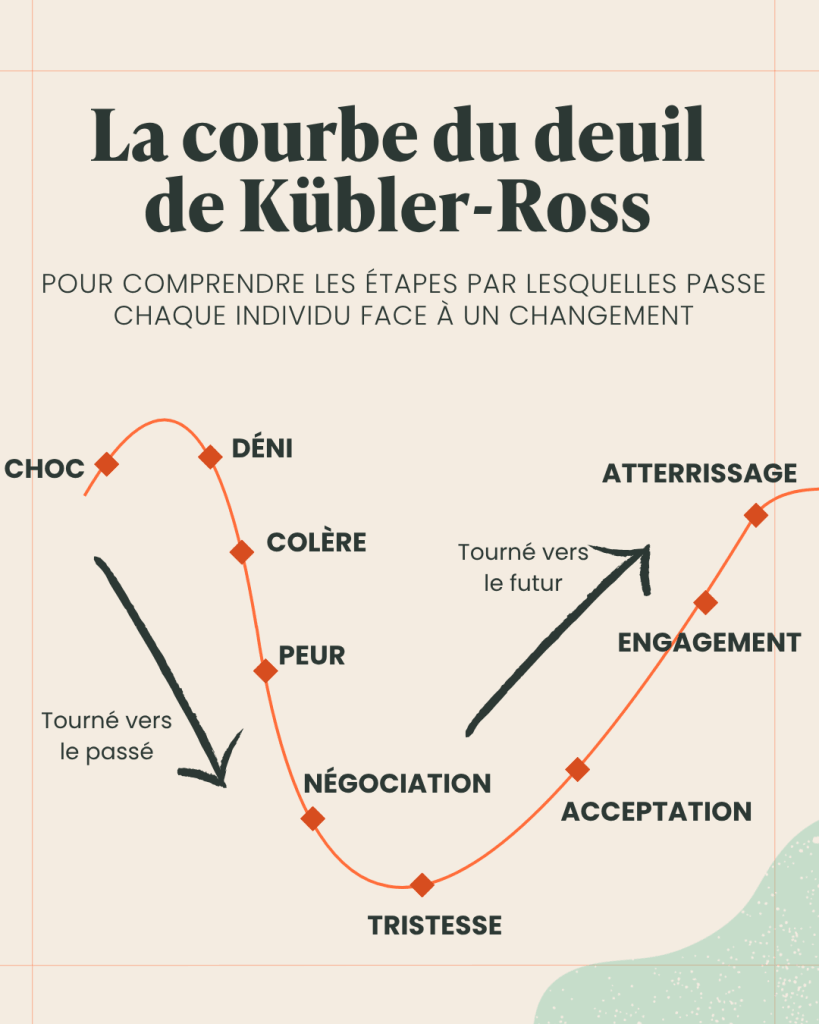
Elisabeth Kübler-Ross developed her five-stage model (denial, anger, bargaining, depression, acceptance) to describe how people process terminal illness and loss. It has since become one of the most borrowed frameworks in organisational life, and for good reason: a transformation project is, structurally, a series of small losses. Loss of a familiar tool, a known process, a role people had mastered, sometimes a team they’d built their identity around.
Applying the grief curve to change management isn’t a metaphor stretched too far. It’s a reminder that resistance is not a character flaw, it’s a normal, sequential, and largely predictable human response to loss.
The five stages, in a project context
Denial — “This won’t really happen,” or “It won’t affect my team.” Early skepticism that a new system, process, or structure will actually be implemented as announced.
Anger — Once the change becomes real, frustration surfaces: at leadership, at the timeline, at the loss of what worked before. This is often the stage teams and leaders find hardest to sit with, because it looks like opposition. It’s usually just grief with nowhere else to go.
Bargaining — Attempts to negotiate a partial version of the change: keep the old system running in parallel, delay the rollout, exempt one team. Not obstruction: an attempt to retain some control over the pace of loss.
Depression — A dip in energy and engagement once the bargaining fails and the change is confirmed as final. Productivity often drops here, which is exactly when many projects panic and add more communication, when what’s needed is patience and support.
Acceptance — Not enthusiasm, necessarily, but a willingness to engage with the new reality and start rebuilding competence and confidence within it.
What this changes about how you lead
Two practical shifts follow from taking this seriously.
First, the timeline. People don’t move through these stages at the same pace, and they don’t move through them once. A team can cycle back into anger or bargaining when a second wave of change lands on top of the first, which is common in multi-year transformations. Expect it; don’t treat it as a relapse or a failure of the first change effort.
Second, the response. Denial doesn’t need more facts. Anger doesn’t need to be argued with. Bargaining doesn’t need to be shut down immediately. Sometimes a genuine, bounded negotiation (a two-week delay, a pilot team) does more to build trust than a flat refusal. Each stage calls for a different kind of presence, not a louder version of the same message.
Where it fits in a support plan
At The Change Society, this is one of the first things we map on Day 1 of the Academy training: not to diagnose individuals, but to give project leads a shared vocabulary for what they’re seeing on the ground, so that a team that looks “resistant” in month two can be read, instead, as a team still in bargaining, needing a different kind of support than a team that’s already checked out.
Grief has an end point. So does resistance, if it’s given the room to move through its stages rather than being managed away.
If you wish to be supported during your transformation projects, we invite you to schedule a meeting with The Change Society Office.